-
Tian Dong Industrial Park, Decheng District Economic and Technological Development Zone, Dezhou City

Slip Resistance Standards And How Mats Are Tested
You know that moment at an ice rink. It’s busy. People track in slush. Someone runs to the snack bar. Then—whoops—one slip, one spill, now everybody’s staring.
If you sell, spec, or buy mats, you can’t just say “make it grippy.” You need a test method. Otherwise you’re guessing, and guessing gets people hurt.
This is where slip resistance standards help. They give you a shared language. They also make vendors stop hand-waving.
Below is the real-world version. No fluff. Just what the standards measure, how labs test, and what you should ask for on a report.
Table of Contents
Slip resistance basics
Coefficient of friction (COF) is the “how slippery” idea
Slip resistance usually comes down to friction. More friction = more traction. Less friction = more slide.
Standards measure this in different ways, so don’t compare numbers from two different tests like they’re the same thing. They’re not.
You’re testing two slip problems, not one
Most people only think about the top surface. That’s half the story.
- Top surface traction: shoe/boot (or bare foot) vs mat surface.
- Bottom surface grip: mat backing vs floor, so the mat doesn’t “walk” or creep.
If the mat slides as a whole, the best top texture in the world won’t save you. This is a classic “mat creep” headache on smooth concrete or sealed epoxy.
BS EN 16165 pendulum test (PTV)
What the pendulum test is doing
The pendulum test (often called the “pendulum”) swings a rubber slider across the surface. The device measures how much energy it loses. More loss usually means more slip resistance.
People like it because it’s widely used in the UK/EU world, and it can be done in controlled wet conditions. It’s also a common tool for traction audits in facilities.
PTV quick-read table (common rule-of-thumb)
Different industries use guidance bands to explain the value in plain language. A common quick read looks like this:
| Pendulum Test Value (PTV) | Practical read | Typical message to a buyer |
|---|---|---|
| 0–24 | Higher slip risk | “This surface is risky when wet. Fix it.” |
| 25–35 | Moderate slip risk | “Might be ok, but watch the conditions.” |
| 36+ | Lower slip risk | “Usually safer, if installed right.” |
Don’t treat this like a magic pass/fail sticker. The test conditions still matter a lot.
ASTM E303 British Pendulum (US-friendly wording)
Why you’ll see it in specs
ASTM E303 is basically the same family of pendulum testing, but the language fits US procurement paperwork better. If your customer says “pendulum,” this is often the ASTM name they’ll point to.
If you sell into mixed markets, it helps to say: “Yes, we can discuss pendulum results,” then ask what standard they’re using so you don’t talk past each other.
DIN 51130 ramp test (R9–R13)
What it measures
DIN 51130 uses a ramp. The test ramps up the angle until a person starts slipping. It’s commonly run with oil contamination and safety footwear. The result becomes a class like R9 to R13.
In plain words: higher class = better performance in oily, industrial-style mess.
Where it shows up
You’ll see this logic in:
- commercial kitchens
- food processing
- workshops and maintenance bays
- anywhere “wet + grease + boots” is normal life
DIN 51097 barefoot ramp test (A/B/C)
Different test, different world
DIN 51097 also uses a ramp, but it targets barefoot wet areas. The results are A / B / C.
This shows up in:
- locker rooms
- showers
- pool decks
- spa zones
- rink changing areas where shoes come off
Don’t mix up DIN 51130 and DIN 51097. One is shoes + oil. The other is barefoot + wet. Two different slip stories.
NFSI B101.1 wet SCOF
Why North America asks for it
NFSI B101.1 focuses on wet static coefficient of friction (SCOF). Static friction is that “starting grip” when someone plants a foot and begins to move.
This is useful when buyers want a simple, repeatable way to compare surfaces under wet conditions. It’s also used in safety programs and risk reviews.
Static vs dynamic friction (simple version)
- SCOF: grip when you start moving.
- DCOF: grip while you’re already moving.
Both matter. A mat can feel fine standing still, then get sketchy mid-step. Yeah, that happens.
EN 13893 DCOF
Why DCOF gets attention
EN 13893 is often tied to dynamic friction. Dynamic tests can better reflect real walking, because people don’t freeze-frame between steps.
If your site has a “fast pace” zone—think rink entrances, concessions, or busy corridors—DCOF-style thinking becomes important.
Test conditions you must write down (or the data means nothing)
Here’s the part people skip, then regret later.
Wet, dry, or contaminated?
A “dry” result won’t protect you on a rainy day. If your scenario is wet, ask for wet testing. If you expect oil or detergent, say so. “Wet” isn’t one thing. Water and soap don’t behave the same.
Footwear matters
Work boots, sneakers, rental skates guards, barefoot—each one interacts different with texture. If your customer base is mixed, test the worst case.
Temperature and wear matter too
Cold floors, worn textures, and ground-in grit can change performance. A brand-new sample can look amazing, then the surface “polishes” after real traffic. It’s not always dramatic, but it’s real.
Mat movement and edge curl (the stuff that causes incidents)
Even if the surface tests well, you can still lose the game if:
- the mat creeps (slides slowly)
- the corners curl
- seams gap
- edges become a trip hazard
So you should treat “slip resistance” as a system:
- surface traction
- backing grip
- edge design
- installation details (tape, recess, frame, etc.)
Standards comparison table
| Standard / method keyword | What it’s called in meetings | Output | Best-fit scenario | What to ask for |
|---|---|---|---|---|
| BS EN 16165 Pendulum | “Pendulum test / PTV” | PTV | UK/EU walkways, wet entrances | Wet condition? slider type? repeat count? |
| ASTM E303 Pendulum | “ASTM pendulum” | pendulum value | US procurement language | Same: wet/dry, surface condition notes |
| DIN 51130 Ramp | “R-rating” | R9–R13 | shoes + oily contamination | which shoe, oil type, angle class |
| DIN 51097 Ramp | “ABC barefoot” | A/B/C | barefoot wet zones | test solution, surface prep |
| NFSI B101.1 | “Wet SCOF” | SCOF | wet traction comparisons | instrument, wet method, pass criteria |
| EN 13893 | “DCOF” | DCOF | moving-walk traffic | method details, sample conditioning |
Where UHMWPE fits at an ice rink
UHMWPE is famous for low friction. That’s great for some jobs. It’s not great when you want foot traction. So you need to choose the right surface design for the right zone.
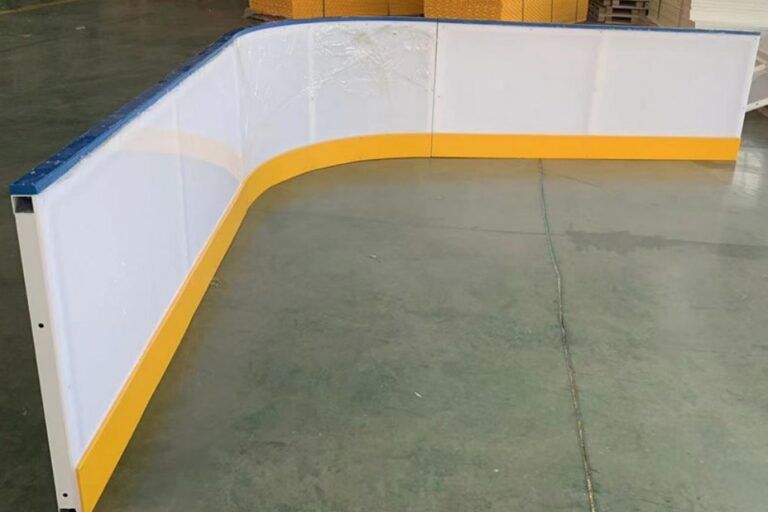
Hockey ice rink dasher boards
Dasher boards need toughness. They also need predictable puck and impact behavior. UHMWPE shines here.
If you want to see how we build rink-side parts, check the product page in your spec review: hockey ice rink dasher boards.
But here’s the trick: the boards are one thing. The walk surfaces around them are another. For walk zones, you usually add texture, ribs, cleats, or a bonded top layer so people don’t skate-walk into trouble.
Ice synthetic panels
Synthetic ice panels focus on glide for skates. That’s the point.
Still, you also have transitions—edges, entry ramps, bench areas. Those spots need extra thought. Here’s the panel reference for your team: ice synthetic panels.
If you design a training zone, a common pain point is the “step-off” area. Skaters come off the panels with guards or wet soles. That’s where you spec higher traction surfaces, not the same slick glide finish.
Rubber backing and hybrid builds (where “Dongxing Rubber” comes in)
If you need a mat that stays put, you can spec a rubber backing or a hybrid construction. Some buyers source rubber layers from suppliers like Dongxing Rubber to increase floor grip and reduce mat creep.
That combo can work well: tough plastic top + grippy rubber base. It’s a very normal, factory-floor kind of solution.
The argument I’ll make (and yeah, I’m gonna be blunt)
Stop buying mats by feel. Stop saying “anti-slip” like it’s a spec. Pick a standard. Define your conditions. Ask for a report.
If you do that, you get:
- fewer slips and near-misses
- fewer angry calls from site managers
- fewer “this mat is trash” returns
- cleaner communication between buyer, safety, and supplier
And if you’re buying in volume, that’s where OEM/ODM and consistent QC really pays off. At Dongxing Rubber level or engineering plastics level, the win is repeatability. Same texture. Same backing. Same performance.
We build high-performance engineering plastic products, and we support custom runs, wholesale volume, and OEM/ODM. If you need samples fast, we can move quick (samples in days, production in weeks, and a fast response). No drama, just clear specs.
If you want, tell me your main scene (rink entrance, locker room, kitchen, or industrial bay). I’ll suggest which standard language to use in your RFQ, and how to write the test conditions so vendors can’t wiggle out of it.