-
Tian Dong Industrial Park, Decheng District Economic and Technological Development Zone, Dezhou City

How To Choose Sheet Thickness: Load, Span, and Fastening Basics
High-Performance Engineering Plastic Products Manufacturer — UHMWPE & HDPE sheets, ground/road mats, fender pads, ice products; OEM/ODM; quick samples; bulk orders welcome.
You want a UHMWPE/HDPE sheet that doesn’t sag, crack, or rattle. You also don’t want to overbuild. Let’s keep it simple: choose thickness by three levers—load, span, and fastening. We’ll focus on UHMWPE/HDPE Quick Mats for ground protection and access roads, since that’s a common ask. (If you need a starting point, see our Quick Mats page.)
Table of Contents
Why Thickness Choice Matters
UHMWPE and HDPE are tough, slick, impact-resistant. But plastic is not steel. For mats, two things control feel and safety:
- Stiffness under live load (vehicles, foot traffic, tracked equipment).
- Support pattern (soil, ballast, sleepers, or frame rails) → that’s your span.
Pick thickness by how far the sheet must bridge between supports, and how much load it must carry without ugly deflection. We also lock the sheet with proper fasteners or couplers so panels work together, not alone.
Plain talk: short spans = thinner mats often OK; long spans = go thicker or add supports.
Core Principle1 — Load (Uniform vs. Point)
Loads come two flavors:
- Uniform pressure: people, light carts, turf protection, general site traffic.
- Point/line loads: wheel paths, trench plates, outrigger feet, tracks, knuckles.
Point loads punish thin sheets. The contact patch is small; pressure spikes. UHMWPE/HDPE distributes load, but if the soil is soft, the sheet spans more and deflects more. For outrigger feet, you often jump thickness or add spreader plates. For pedestrian-only scenes, thinner is usually enough.
Action tip: define the heaviest realistic vehicle + ground condition. “Dry compaction” vs. “wet clay” is a big difference. If in doubt, treat it like soft ground.
Core Principle2 — Span (Support Spacing)
Span is the clear distance between supports: ground high spots, timber bearers, sleepers, or subframes. When span grows, bending grows fast. No magic here.
- Add sleepers more closely → you can drop thickness.
- Use the natural crown of firmer ground → you reduce effective span.
- For temporary roads, a grid of sleepers creates predictable spans (nice trick when soil is moody).
Short sentence truth: Span kills thin sheets. Cut the span, or thicken the panel.
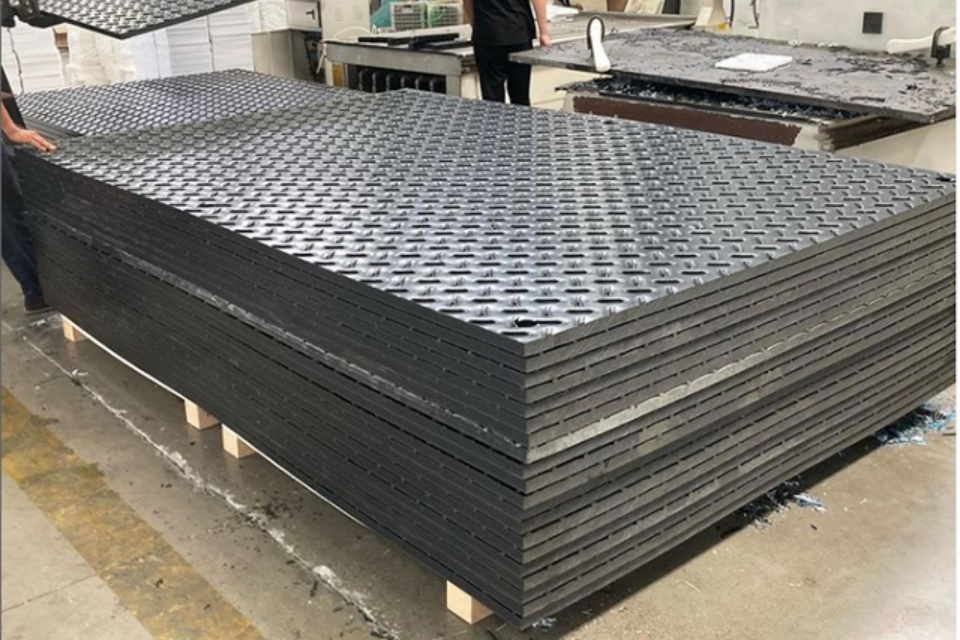
Core Principle3 — Fastening Basics (Couplers, Bolts, Edge Distance)
Fasteners don’t just “hold it down.” They share load between sheets. Without ties, a wheel sits on one panel; with ties, it recruits neighbors. That cuts deflection and improves feel.
- Couplers / connectors: keep panels flush, reduce trip edges.
- Bolt-through with washers: spreads bearing in plastic; avoid tiny washers.
- Edge distance: don’t drill too close to the sheet edge.
- Pitch (spacing): closer spacing in high-load lanes; wider elsewhere.
And yes, sheet must be thick enough for the fastener style you choose. Super-thin plus aggressive fastener = risk of pull-through.
Quick Decision Table (Field-Friendly)
These are starting points for UHMWPE/HDPE Quick Mats. Actual choice depends on soil, moisture, real axle loads, and support plan. When in doubt, reduce span or upsize thickness. No need count every penny cost; we focus on safety & reliability.
| Use Case (Scene) | Typical Load Type | Ground / Support | Span Guidance | Thickness Direction | Fastening Note |
|---|---|---|---|---|---|
| Pedestrian paths / event turf | Uniform, low | Firm turf or plywood underlay | Short spans (ground-backed) | Thin–medium sheet | Light couplers; avoid trip lips |
| Light vehicles (UTVs, pickups) | Mixed (wheel path) | Compacted soil with sleepers @ short c/c | Control span with sleepers | Medium sheet | Tie panels at wheel lanes |
| Construction access road | Concentrated wheel loads | Sleepers or crushed base, tighter spacing under wheel tracks | Keep span tight (under wheel line) | Medium–thick | Couplers + periodic bolt-through rows |
| Tracked excavator traffic | High, line loads | Crushed base + sleepers | Very short effective span | Thick | Reinforced couplers; edge distance ≥ good practice |
| Outrigger pads / crane feet | Severe point load | Rigid spreaders under sheet | Treat as plate under point load | Thick + spreader | Large washers/plates; no close-edge drilling |
(“Thin/Medium/Thick” refers to your in-house spec ladder; we map it with you.)
A Simple, No-Drama Workflow
- Name the load. What’s the heaviest thing rolling or standing? Wheel type, track type, outrigger pad size.
- Set a deflection target. For a road feel, you want low bounce. In practice, many teams aim for a “stiff feel,” not visible sag.
- Plan the span. Decide sleeper spacing or confirm ground bearing. Shorten spans where wheels actually run.
- Pick a thickness candidate. Use your internal ladder: thin / medium / thick.
- Lock the edges. Choose couplers/bolts and spacing so panels act like a team.
- Reality check. Soft soil today? Rain last night? If softer than expected, either add sleepers or jump one thickness.
- Pilot bay. Lay 2–3 panels, drive the actual machine, look and listen. If it feels bouncy, fix span or thickness. Easy.
Practical Scenarios
- Warehouse yard, light trucks: You plan 2x sleepers at 0.6–0.8 m c/c under wheel lines. A medium mat rides tight, no obvious dip. Tie the transverse seams so the wheels don’t pry up edges.
- Wind farm approach, soft clay: Rain turns it to soup. You cut sleeper spacing in half under the wheel track. Same medium mat now behaves. No need to jump straight to ultra-thick; span control saves the day.
- City crane, tight street: For outriggers, you stack thick UHMWPE pads with a steel or timber spreader to enlarge the contact area. Edge distances good, bolt-through with large washers where needed. Calm and safe. Use real outrigger pads when you need repeatable support.
- Event boardwalk: Pedestrian-only? Thin–medium is fine over firm turf, but still clip the joints; no one loves a toe-catch.
Fastening: Small Details, Big Difference
- Orientation: Stagger seams so you don’t create a straight “hinge” line across the roadway.
- Washer size: Use large OD washers or dedicated bearing plates; tiny washers chew plastic.
- Edge distance: Keep holes back from edges (don’t hug the corner).
- Serviceability: Choose hardware you can remove fast; projects move quick, we get it.
Silly phrase but useful: Tie it, or try it again. Un-tied mats always misbehave under turning loads.

Why UHMWPE/HDPE Quick Mats (vs. wood or steel)?
- Impact & abrasion resistance: Tracks and gravel are rough; UHMWPE/HDPE shrug it off.
- Low moisture absorption: They don’t swell; they stay dimensionally stable outside.
- Light handling: Faster to deploy and flip.
- Surface texture options: Traction where you need it, smooth where you don’t.
- Ice Rink Products are part of our portfolio too; if you need that surface, check Ice Rink Products for matched materials.
And if you need hybrid solutions—plastic surface on steel frame, or custom thickness stacks—we do OEM/ODM. We are set for bulk wholesale, custom sizing, logo engraving, and repeat batch production. Samples are quick, production is fastly, response is 24-hour.
Small Table: Span–Thickness–Feel (Rule-of-Thumb)
Use to start internal discussion; you’ll tune it to your ground and fleet.
| Effective Span Between Supports | Pedestrian | Light Vehicle | Heavy Vehicle / Tracks |
|---|---|---|---|
| Ground-backed / very short | Thin OK (stiff feel) | Thin–Medium (watch bumps) | Medium (tight fasteners) |
| Short | Thin–Medium | Medium | Medium–Thick |
| Moderate | Medium | Medium–Thick | Thick + extra sleepers |
| Long (don’t do this) | Medium (springy) | Thick (still bouncy) | Rethink span → add supports |
If you read this table out loud: when span grows, thickness grows. If span is long and soil is soft, don’t argue with physics—add supports.
Quality & Supply Notes
We manufacture Ground Protection & Road Mats, Ice Rink Products, Engineering Plastic Sheets (UHMWPE/HDPE/PP/PE/Nylon) with customization, bulk wholesale, and OEM/ODM. If your project needs companion rubber items—gaskets, anti-slip pads, edge bumpers—our long-term partner Dongxing Rubber can integrate that, so you get one coordinated kit, not five boxes from five vendors.
One team, one spec, fewer surprises.
Wrap-Up
- Define your worst-case load and real support plan.
- Start with a thickness candidate that matches span.
- Fasten panels so they share load.
- Pilot a short lane and adjust. It’s quick and saves rework later.
If you share your vehicle types, soil condition, and target span, we’ll map you to a Quick Mats thickness and fastening layout that feels right—no drama, no overbuild.