-
Tian Dong Industrial Park, Decheng District Economic and Technological Development Zone, Dezhou City

Case Study: Reducing Ground Subsidence With UHMWPE Pads
When a crane or concrete pump sinks into the ground, nobody is happy.
You lose time, rework the ground, maybe even stop the whole lifting plan.
In this case study, we’ll look at how UHMWPE pads help you cut ground subsidence on real jobsites, and why working with a high-performance engineering plastic manufacturer like Dongxing Rubber makes this more repeatable, not just lucky.
Table of Contents
Understanding Ground Subsidence Under Crane Outriggers
On paper, the crane looks safe. You checked the load chart, rigging, radius.
Then the real world hits:
- Soft backfilled soil
- Hidden trenches or poor compaction
- Concrete that is strong on top but weak under the surface
The outrigger feet push all that load into a very small area.
If the soil bearing capacity is lower than the pressure, the ground starts to settle. Not always fast. Sometimes it creeps a few millimeters, then more, until the crane leans and the operator feels something is “not quite right”.
So the core question is simple:
How do we spread the outrigger reaction so the ground stays inside a safe stress window?
That is exactly where UHMWPE outrigger pads come in.

How UHMWPE Outrigger Pads Reduce Ground Subsidence
Load Distribution And Soil Bearing Capacity
UHMWPE pads work like load spreaders.
You keep the same outrigger force, but you increase the contact area, so the pressure on the ground goes down.
Engineers often use a basic formula on site, even if they don’t write it down:
Required pad area ≈ Outrigger load ÷ allowable ground bearing pressure
If you oversimplify this and use too small pad area, the soil is overloaded and settlement happens.
With large UHMWPE pads, you bring the pressure closer to the design bearing capacity, which keeps subsidence under control.
- Bigger pad → lower pressure
- Lower pressure → less settlement
- Less settlement → safer crane stablity and less drama on site
Compressive Strength And Shape Retention Of UHMWPE
Spreading the load is not enough if the pad itself crushes or deforms too much.
UHMWPE has:
- High compressive strength
- Very good elastic recovery
- Low water absorption
So even under heavy outriggers, the pad keeps its shape and spreads the load evenly.
It “follows” small bumps in the ground but does not collapse like soft timber.
This means the effective contact area stays big during the whole lift, not just at the first minute.
Less local punching, less creep, less secret subsidence under one corner.
Durability Compared With Wood And Steel Pads
Many contractors still use timber mats or steel plates because “we always did like this”.
But they bring problems:
- Wood rots, splits, absorbs water, swells in freeze-thaw enviroment
- Steel rusts, is heavy to handle, and can damage finished concrete or asphalt
- Both can become uneven over time, so the load distribution is no longer predictable
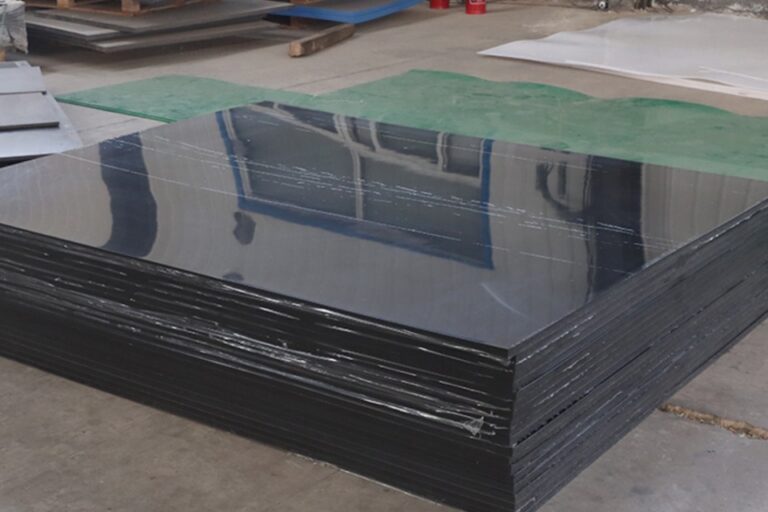
UHMWPE pads, machined from UHMWPE HDPE sheets and plates or HDPE sheets, stay:
- Corrosion-free
- Waterproof
- Chemically resistant
So the mechanical behaviour of your pad is stable from job to job.
Stable pads + known soil conditions = more repeatable control of ground subsidence.

Simple Pressure Comparison: Foot Vs UHMWPE Pad
Let’s use a very simple, not-perfect numbers example.
You just want to show your customer what happens when you change pad size.
Assume:
- One outrigger carries a heavy load
- We compare different pad sizes
(Values below are illustrative to show the trend, not exact design data.)
Table 1 – How Pad Area Changes Ground Pressure
| Scenario | Foot / Pad Size (m) | Area (m²) | Ground Pressure (relative) | Subsidence Risk (qualitative) |
|---|---|---|---|---|
| Bare outrigger foot only | 0.25 × 0.25 | 0.06 | Very high | Very likely, ground overstressed, big settlement |
| Small pad | 0.5 × 0.5 | 0.25 | High | Still risky on soft backfill, possible sink |
| Medium UHMWPE pad | 0.8 × 0.8 | 0.64 | Medium | Usually acceptable on firm soil, limited settlement |
| Large UHMWPE pad | 1.0 × 1.0 | 1.00 | Low | Inside typical soil capacity, subsidence better controlled |
On site you feel it very quick:
- With small pads, the outrigger sometimes “bites” into the ground.
- With larger UHMWPE pads, the crane sits calm, and the lifting supervisor sleeps better that night.

Case Study: Soft Construction Site Upgraded With UHMWPE Pads
Project Background
A contractor worked on a mid-rise building project with:
- Mobile crane for prefabricated concrete elements
- Backfilled soil around the new basement
- Old practice: mixed timber pads and small steel plates
During early lifts, they saw:
- Outriggers sinking a few millimetres into the backfill
- Need to stop, add more soil and compact again
After a near-miss where a lift had to be aborted because of visible tilt, management decided to try custom UHMWPE outrigger pads from Dongxing Rubber, using material from their UHMWPE sheets product line.
Implementation
The team did three simple things:
- Checked the soil bearing capacity from the geotechnical report.
- Selected larger UHMWPE crane pads to keep pressure within a comfortable safety margin.
- Standardised pad use in the lifting plan, not just “if operator feels like it”.
Result Snapshot
After several months and many lifts, the site team reported clear differences.
Table 2 – Before/After Using UHMWPE Pads On Soft Ground
| Item | Before (timber + small steel) | After (UHMWPE pads) |
|---|---|---|
| Ground subsidence under outriggers | Frequent small sinks, visible uneven settlement | Very limited settlement, mostly elastic recovery |
| Time lost to re-levelling and re-compacting | Regular delays, ad-hoc ground repairs | Only occasional minor adjustments |
| Operator confidence | “Crane feels like it is walking” on some lifts | Stable feeling, easier to follow the lift plan |
| Damage to ground / temporary slabs | Crushed spots, broken edges | Surface stays much cleaner and more uniform |
| Safety perception by client | Worried after near-miss event | Higher trust once pads were standardised |
Is it magic? No.
It’s just better load spreading, higher compressive strength, and consistent behaviour from quality material.
Business Impact For Contractors And Rental Fleets
Reducing ground subsidence is not only about safety. It is also about business.
With UHMWPE pads you:
- Cut unplanned downtime for re-levelling
- Reduce risk of structural damage to finished concrete or underground services
- Make your lifting plan and risk assessment more solid, not just on paper
- Improve your professional image with end clients and EPCs
For rental fleets, there is another angle:
- Lifting kit goes out with standardised pad sets
- Less argument with customers about ground failures
- Better KPI for utilisation and incident rate
These things don’t show up on the crane spec sheet, but they matter in daily operations, and your sales team can talk about them in very simple language.
Why Work With Dongxing Rubber For Custom UHMWPE Pads
Dongxing Rubber is positioned as a high-performance engineering plastic products manufacturer.
We don’t only sell flat stock. We help you turn engineering plastic into real ground protection mats and outrigger pad solutions.
From our product range:
- UHMWPE & HDPE sheets and plates form the base stock for outrigger pads, crane mats, and spreader plates.
- We also support ground protection mats, ice rink panels, MG engineering plastic sheets, nylon sheets, and PP/PE products for other scenes on the same jobsite.
For you as a contractor or wholesaler, that means:
- OEM/ODM support for your own pad brand, backed by our OEM/ODM services
- Batch production for distributors who serve multiple crane or pump companies
- Custom machining for special pad shapes, lifting eyes, handles, anti-slip faces
You bring the soil bearing capacity data, typical outrigger loads, and site scenarios.
We bring the material know-how, machining, and quality control.
Together we build a pad solution that:
- Keeps ground pressure inside safe limits
- Reduces subsidence and creep
- Fits your logistics and storage habits